Équations du premier degré: Équations et inéquations du premier degré
 Points d'intersection d'une droite avec les axes
Point d'intersection avec l'axe des x
Exemple
Exemple
Considérons l'équation de droite #y=-3 \cdot x - 4#.
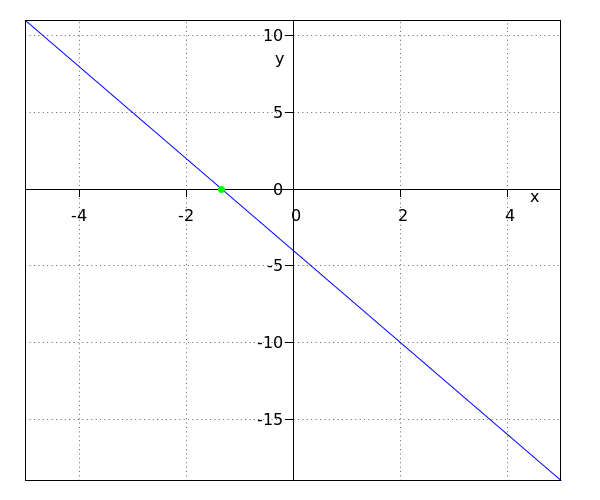
Le point d'intersection avec l'axe des #x# peut être trouvé en résolvant #-3 \cdot x-4=0#.
\[\begin{array}{rcl}-3 \cdot x -4 &=& 0\\ && \phantom{xxxxx}\blue{\text{équation}} \\ -3 \cdot x &=&4 \\&& \phantom{xxxxx}\blue{\text{addition de }4\text{ aux deux membres}} \\x&=&-\frac{4}{3}\\ && \phantom{xxxxx}\blue{\text{division des deux membres par }-3} \end{array}\]
Donc le point d'intersection avec l'axe des #x# est: #\rv{-\frac{4}{3},0}#.
Point d'intersection avec l'axe des y
Exemple
Exemple
Considérons l'équation de droite #y=-3 \cdot x - 4#.
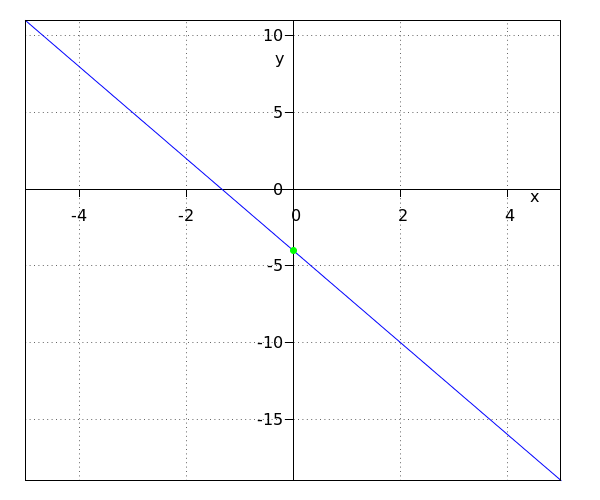
Le point d'intersection avec l'axe des #y# peut être trouvé en substituant #x=0# dans #y=-3 \cdot x -4#. Nous obtenons:
\[y=-3 \cdot 0+4 =4\]
Donc le point d'intersection avec l'axe des #y# est: #\rv{0,4}#.
#q=5#
Si #\rv{p,0}# appartient à la droite, alors nous obtenons #5 p + 3\cdot 0 = 15# (en substituant #x=p# et #y=0# dans #5 x + 3 y = 15#). Ceci est une équation d'inconnue #p# où #p=3# est la solution.
De même, en substituant #x=0# et #y=q# dans l'équation #5 x + 3 y = 15#, nous obtenons l'équation #3\cdot q = 15# où #q=5# est la solution.